
When working with leadership teams, it’s important to gauge team trust.
Often, the way they answer that question and the way I see them treating each other give me a very different answer. In fact, I often find that individual leaders have very different views and definitions of “trust.”
Have you ever heard of the concept of a “trust battery”? I first learned about the trust battery concept from Gustavo Razzetti, founder of Fearless Culture. Tobi Lütke, CEO of Shopify, originally popularized the idea, and it’s a powerful way to think about how trust actually works
What’s a “Trust Battery”?
Imagine it’s a gift-giving holiday (e.g., birthday, Christmas, Hanukkah, etc.) and you’ve purchased electronic toys for your kids. Each one came with its own battery. One arrived fully charged. A few arrived half-charged, while others had no charge or no battery at all.
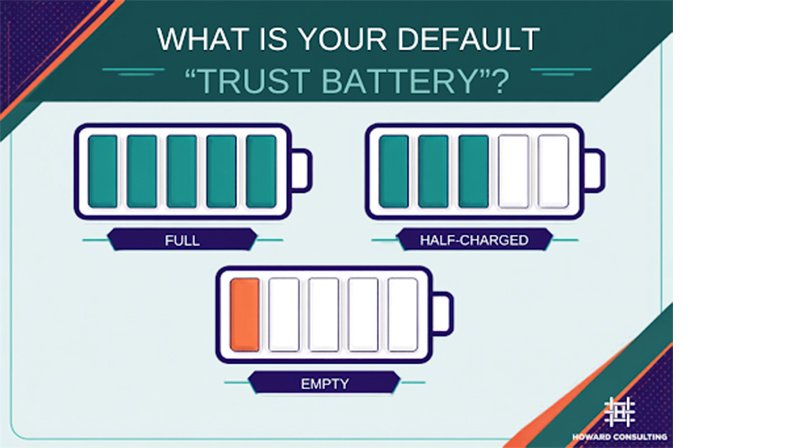
When you meet someone new, how much do you trust them? Think of it as a “trust battery,” where the charge level depends on how much trust we give someone when we meet them versus how much they must earn.
Some of us assign someone a fully charged trust battery from the get-go; we assume the best of people until they give us a reason not to. Some people start with a half-charged trust battery; we’ll give them the benefit of the doubt, but they still need to earn more. And still others start with a completely empty trust battery; everyone starts at zero and has to prove themselves before you’ll trust them at all.
What This Looks Like on a Real Team
While there’s no wrong answer, we need to understand that each person we work with has a different default setting for their “trust battery.” If you’ve never had a conversation about it, invisible friction is likely getting in the way of building trust.
I recently worked with a team where people felt stuck. They would commit to things in meetings, then go back to their individual departments and act as if the conversation never happened. I noticed frustration, finger-pointing, and an increasing sense that people felt they couldn’t count on each other.
When we dug in, the issue was clearly about trust. More specifically, it stemmed from an erosion of trust from too many broken commitments over time.
Some team members had started with full batteries. But after watching colleagues say one thing and do another, those batteries had drained. Other team members had always started half-charged by nature. Instead of feeling recharged through successful working relationships, the pattern of unmet commitments confirmed their instinct to hold back, so their batteries never recharged.
The result? A leadership team that couldn’t get to real commitment or accountability because a foundational level of trust was never there.
Three Diagnostic Questions
If you want to know how much team trust exists on your team, here are three questions worth asking:
1. When someone disagrees in a meeting, what happens next?
In teams with strong trust, disagreement is a catalyst for reaching better decisions. People push back, ask hard questions, and challenge stated (or unstated) assumptions. They believe their input matters and won’t be held against them.
In teams without trust, disagreement either doesn’t happen (people stay quiet to avoid conflict) or it gets personal (people get defensive, assuming bad intent behind any pushback).
Observe your next leadership meeting. When someone raises a concern, do others lean in with curiosity or lean back with defensiveness?
2. What does silence in your meetings actually mean?
Silence can mean a lot of things. Sometimes it means agreement. Sometimes it means people are thinking.
Often, silence means something else entirely: people have stopped believing their voice will make a difference.
One leader I worked with told me that her team’s silence used to frustrate her. She’d ask for input and get nothing. It wasn’t until she had one-on-one conversations that she learned the truth: people had tried to speak up before, and it hadn’t gone well. So they stopped.
If your meetings are quiet, don’t assume alignment or agreement. Ask yourself: have people learned that speaking up comes with a cost? Try assuming silence means a lack of alignment or agreement. How does that change the outcome?
3. After a conflict or missed commitment, how do you repair damaged team trust?
Every team will have moments where trust gets damaged. Someone drops the ball, a commitment doesn’t get met, or a conversation goes badly.
The question isn’t whether those moments will happen. The question is: what happens WHEN they happen? What happens AFTER they happen?
In high-trust teams, there’s a clear path. People acknowledge what happened, take responsibility, and follow through on what they say they’ll do next. The repair itself becomes a trust-building moment.
In low-trust teams, conflicts hang around. People avoid the hard conversations, resentment builds, and the next missed commitment feels like confirmation that nothing will ever change.
Trust Isn’t Built in a Retreat
Here’s what I’ve learned from working with organizations: a single offsite or team-building exercise won’t build trust.
Rebuilding trust takes small, consistent actions over time. Things like following through on what you said you’d do. Having the hard conversations instead of avoiding them. Checking in on commitments instead of simply hoping they’ll happen.
Building trust will likely require open conversations, vulnerability, and sustained follow-through. It’s an ongoing practice that requires patience and intentional effort.
If your leadership team is struggling with commitment or accountability, start by looking at the trust underneath. Because you can’t hold people accountable if they don’t trust each other enough to be honest about what’s actually happening.
What is your default trust battery level?
Try this:
In your next leadership meeting, ask each person: “When you meet someone new, what’s your default trust battery level—full, half-charged, or empty?”
Then ask: “Has anything happened on this team that’s changed how you view your default battery level?”
You might be surprised by what surfaces. That conversation alone can be the start of rebuilding trust.
P.S. Subscribe to the Culture Threads newsletter for more on how to shape your culture, delivered weekly.
