
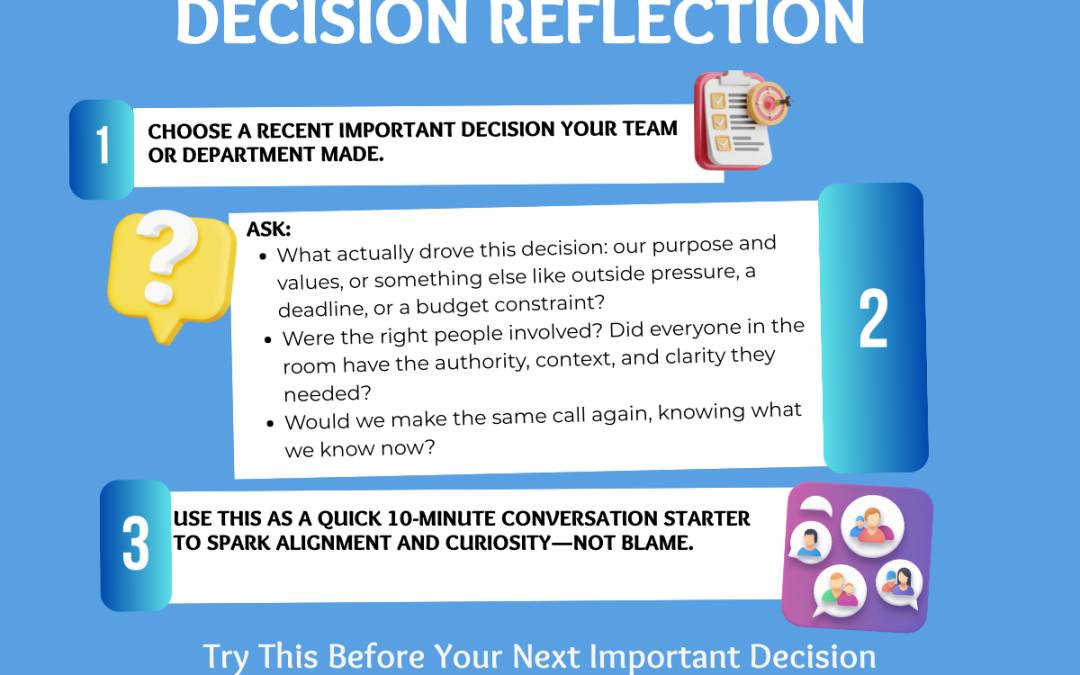
Here’s a question I find myself coming back to again and again, whether I’m sitting with a leadership team for the first time or knee-deep in a culture assessment: when your team makes decisions, what’s actually driving them?
I’ve worked with many purpose-driven organizations, and the answer is supposed to be simple. Mission. Values. The people you exist to serve. And to be clear, budget and speed matter too. They’re legitimate factors in any organization’s decision-making, nonprofit or otherwise.
But there’s a difference between consciously weighing those factors as part of a shared process and letting them override that process arbitrarily. What I see more often than I’d like is the latter. A board member applies pressure. A funder deadline creates urgency. And suddenly a decision gets made in a way that bypasses the people, the values, and the process that should have been part of it.
And when that happens, people notice. Maybe not right away. But they notice.
Decision-Making Is a Culture Signal
How decisions get made in your organization is one of the clearest signals your culture sends. Not what you decide, but how. Who’s in the room. Who gets asked. How much has to be explained afterwards.
When decision-making is clear and consistent, people feel it. They trust leadership more. They’re more willing to raise concerns or bring new ideas. They feel like they’re part of something.
When it’s murky or inconsistent, that trust erodes quietly. And one of the most telling signs? The meeting multiplication.
The Meeting Multiplication Problem
A decision needs to be made, so a meeting gets scheduled. But before that meeting, certain people huddle to build their case. Then the meeting happens. Then, after the meeting, another subset gets together to decide whether to accept the outcome or push back, which often leads to yet another meeting. And another.
If that cycle sounds familiar, it’s a signal. It means people don’t feel safe speaking up in the room where it counts. It points to a lack of trust, accountability, and commitment, and those things don’t stay contained to one meeting. They show up in how people collaborate, whether they follow through, and whether they’re actually invested in the outcome. And it means a lot of time and energy is going into managing decisions rather than making them. For nonprofit organizations, especially, where capacity is almost always stretched, that’s not a minor inefficiency. Time spent in pre-meetings and post-meetings is time that doesn’t come back. It’s time that could have gone toward serving clients, writing grants, supporting staff, or doing the actual work your organization exists to do.
This isn’t a communication problem. It’s a design problem. Organizations don’t usually end up with messy decision-making because their leaders are careless. They end up there because no one ever sat down and decided how decisions should work.
What Happens When There’s No Shared Process
When decision-making is unclear, a few things tend to follow. People don’t know who owns a decision or when they have standing to weigh in. Leadership choices that might be totally reasonable start to feel arbitrary or top-down because there’s no visible framework people can hold them up against. And over time, the gap between what the organization says it values and what actually happens in practice gets harder to ignore.
I heard a version of this repeatedly in the interviews I conducted for the 2025 U.S. Nonprofit Culture Pulse report. One leader described a dynamic that stuck with me: their organization had clear values on paper, but as she put it, “as hard as I’ve tried to get them into our regular cadence of conversation, they haven’t really made their way into how we talk about the work.” The values existed. The decisions were happening. The two just weren’t connecting.
It’s Not Always About Values
And sometimes the confusion isn’t about values at all. It’s about authority. I recently worked with an executive leadership team that wasn’t clear about which decisions each of them actually had the authority to make. No one had ever defined it clearly. So decisions were either getting made by the wrong people, delayed because no one was sure who should decide, or quietly relitigated after the fact. Sound familiar?
That gap, whether it’s about values or authority or both, is where culture starts to fray.
Story: A New Leader Struggles to Find Her Footing
One client I worked with had just hired a new Executive Director who brought a strong vision and real energy. But some of her early decisions landed harder than she expected.
She was moving quickly, trying to make her mark, and didn’t yet feel fully confident pushing back on long-tenured staff. So she made some assumptions and skipped some conversations that would have made a real difference. From where the team sat, her decisions felt top-down and disconnected from how they’d always operated. It wasn’t that she didn’t care. The shared understanding and process that would have made her intentions clear just didn’t exist yet.
We worked together to create decision-making guidelines: who decides what, under what conditions, and where staff input matters. But more importantly, she brought the team directly into that conversation. That alone shifted the dynamic. People felt heard. Trust started to rebuild. And she became clearer about her own instincts because she and the team finally had a framework to work from.
When the Stakes Are Higher: Mission vs. Funding
Sometimes the decision-making challenge isn’t an internal process. It’s an external pressure that puts your values on the line.
I worked with an organization whose leadership team was wrestling with a significant grant from a funder whose priorities didn’t fully align with theirs. The money was real. So was the debate. People had strong feelings, and there wasn’t a clear way to work through them.
So we built one. A simple framework grounded in three questions: Does this move us closer to our mission? Does it reflect our values? Is it worth the trade-offs?
In the end, they declined the funding. And something interesting happened—rather than feeling like a loss, the decision brought clarity. People left the room knowing exactly who they were and what they stood for. That’s what a shared framework can do.
Another Way to Think About It
When describing what good decision-making looks like in her organization, one of the most striking things a leader said to me during the Culture Pulse interviews was this: “There’s a real value around trying to be clear about how and who is making decisions, especially around things that impact people the most.” She said her team treats decision-making as a participatory process: if something affects everyone, everyone participates in working through it.
That’s not always possible or practical. Not every decision can be collective. But the principle matters: people affected by decisions deserve to understand how those decisions are made, even when they don’t get a vote.
Is Your Team Practicing Purpose-Driven Decision-Making?
Before you can answer that, there’s a more foundational question worth asking: does everyone involved in making decisions actually understand your values, what they mean in practice, and how to use them as a real decision-making lens?
A shared decision-making process is only as good as the shared understanding behind it. I’ve seen teams go through all the right motions and still end up with decisions that feel off, because the people in the room weren’t aligned on what they were measuring against. Sometimes, both options on the table reflect your values. Sometimes only one does. Sometimes neither does. But if your decision-makers aren’t clear on your purpose, values, and priorities, a process alone won’t get you there.
If you’re not sure where your team stands, here are a few questions worth sitting with:
- Do we actually know our values? Not just what they are, but what they mean in practice and how they should show up in the decisions we make?
- How consistent are we? Do we have a shared process, or does it depend on who’s in the room that day?
- What’s actually driving our decisions? Is it our mission, or are speed, budget, or outside pressure quietly overriding our decision-making process?
- Who’s involved? Whose voice is regularly missing, and does that absence match our values?
- Who has the authority to make this decision? Who needs to be consulted before it’s made? Who has to approve it? These aren’t just logistical questions. Unclear roles and responsibilities around decision-making are among the most common sources of friction I see in leadership teams.
- Are we walking our talk? Can we point to a recent decision and say clearly: that reflected who we are?
- How do we know? Are we checking back on decisions over time to see if the outcomes held up?
The Path Forward
If any of these issues feel familiar, that’s not a failure. It’s information. It means there’s an opening to get more intentional, and that’s exactly the kind of work that makes a real difference in culture.
Here are three places to start:
- Get clear on your decision-making principles. What values or priorities should guide the choices your team makes? Write them down. Make them specific enough to actually be useful when things get hard. And be honest about the other factors, like budget and timing, that will legitimately come into play. A good framework doesn’t ignore those. It gives you a way to weigh them intentionally rather than haphazardly.
- Create a shared framework. It doesn’t have to be complicated. Even a simple set of questions that your team can apply consistently is more useful than a process that lives only in the leader’s head. That framework should also be clear about who has the authority to make which decisions, who needs to be consulted, and who needs to approve. Without that clarity, even the best process breaks down.
- Make reflection a practice. Look back at significant decisions regularly. Did the outcomes reflect your mission? Your values? Your priorities? What would you do differently? This isn’t about second-guessing; it’s about learning.
When Decisions Reflect Values, Everything Works Better
Decision-making is one of the most powerful levers you have when it comes to culture. When it’s clear, consistent, and grounded in your values, it builds trust. It gives people something real to orient around. And it closes the gap between what you say you stand for and what it actually looks and feels like to work there.
When your team sees that your decisions reflect what you say you value, they’re more likely to bring their best thinking, speak up when something’s off, and stay.
Let’s Talk About Your Decision-Making Culture
Decision-making is an important part of what we examine together in my Culture Threads Assessment: who decides, under what conditions, and whether those patterns match what the organization says it values. Most of the time, the gap isn’t intentional. It’s simply what happens when decision-making is left to chance rather than design.
If any of this is hitting close to home, that’s a good place to start. Let’s talk about what’s getting in the way.
👉 P.S. Subscribe to the Culture Threads newsletter for resources, stories, and tools you can apply to strengthen culture in your organization, including how to improve decision-making.
