
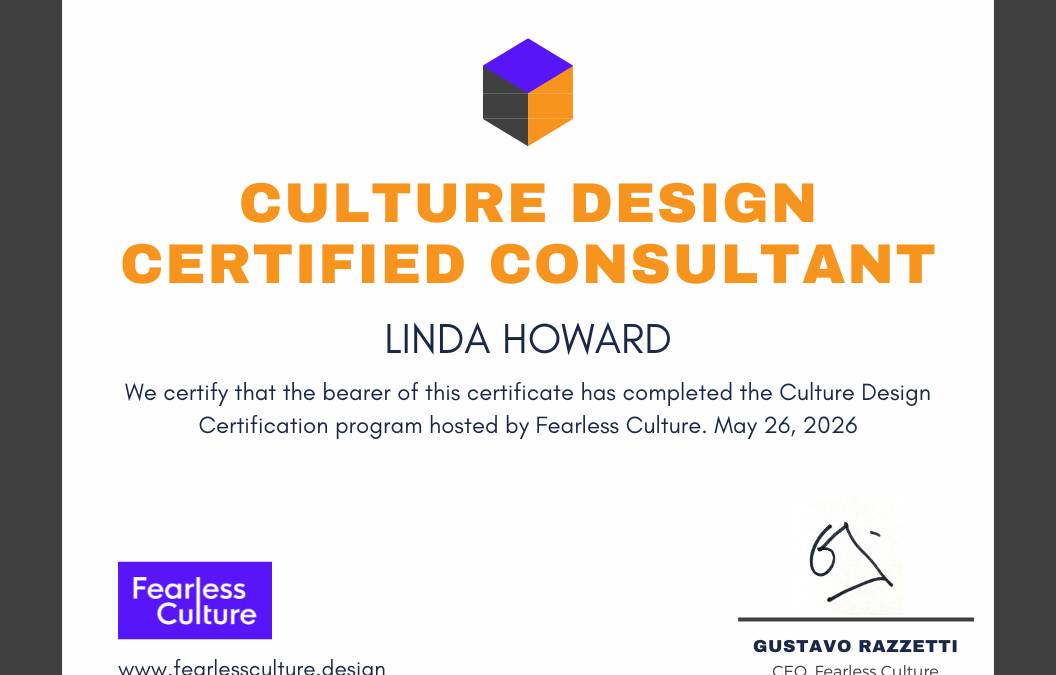
I’ve earned a few certifications over the course of my career. Some were worth the effort. Some felt more like boxes to check. But when I completed my Culture Design Certification through Fearless Culture last month, something felt genuinely different.
Not different like “this was a harder test.” Different, like something finally clicked into place.
And it wasn’t easy to get here. The Culture Design Certification isn’t something you simply sign up for. Before you can even apply, you have to complete both the Culture Masterclass and the Build a Fearless Culture program. Those are just the prerequisites. From there, Fearless Culture runs one cohort per year, and candidates have to apply to be selected.
What I took away from the program turned out to matter far more than the credential itself.
More Than a Culture Design Certification
I’ve spent more than 30 years helping organizations work better, rebuilding trust after leadership transitions, improving how teams communicate, and clarifying how decisions actually get made. For most of that time, I did this work without a clear framework for how it all connected. I could help my clients with each piece. I just didn’t always have language for the whole.
This certification journey gave me that.
When the Pieces Finally Connect
The Culture Design Canvas, developed by Gustavo Razzetti, put structure around work I had been doing largely by instinct. It connected the dots between behaviors, systems, leadership signals, psychological safety, and decision-making in a way that made the whole picture visible. I wrote about how that shift in thinking began in this post, if you want the longer backstory.
What this certification added was depth and coherence. I now see how all the elements of my work relate to one another. How the way a team runs its meetings affects whether people feel safe speaking up. How feedback norms connect to accountability. How a one-time workshop on communication, however good, lands differently than a series of intentional sessions designed around a shared framework with clear outcome goals.
That last point matters to me. When I look back at some of the one-off workshops and retreats I’ve facilitated over the years, I can see now where more defined objectives and a tighter sequence would have produced more impactful results. The clients I’ve worked with through a series of sessions are telling me the same thing. They’re reporting clearer communication, stronger trust, and better follow-through than those who hired me for a single session. The culture framework helps me understand why.
Culture improvement doesn’t happen from a one-day event. It takes ongoing intention and practice.
Curiosity, Commitment, and Lots of Questions
When Gustavo announced my certification on LinkedIn today, he wrote that what stood out in my application and my journey was my curiosity, commitment, and “lots of questions.” He mentioned that I approach every conversation with openness, challenge my own thinking, and embrace the discomfort that real learning requires.
I’ll take that. Because that’s also exactly how I try to show up for my clients.
The Work Ahead
This certification feels like a cornerstone in this phase of my career. It has helped me pull together 30+ years of instinctive work and give it language, structure, and a repeatable framework. I’m grateful to Gustavo for building something practical and rigorous enough to actually use. And I’m grateful to the Fearless Culture community of consultants and culture advisors who show up as genuine thought partners and a support system. That kind of community is rarer than it sounds.
I also had the privilege of joining Gustavo’s research team to explore workplace culture patterns in the nonprofit sector, which led to the 2025 U.S. Nonprofit Culture Pulse Report. That work deepened my understanding in ways a certification program alone couldn’t.
I genuinely believe this is the best and most impactful work of my career. After all these years, I don’t say that lightly.
If your organization is navigating a culture challenge, or if you’ve tried a workshop or two and wondered why things didn’t really change, I’d love to have a conversation. Not a sales call. Just a real conversation about what’s going on and whether there’s a practical path forward. Reach out and let’s start there.
P.S. Want practical ideas for strengthening your culture? Subscribe to Culture Threads, my newsletter for purpose-driven leaders.
P.P.S. Curious what other nonprofit leaders are experiencing? The 2025 U.S. Nonprofit Culture Pulse Report is free to download.
